Summary: If an elderly parent refuses help, try to understand what sits behind the refusal before pushing for a solution. If they have the mental capacity to make the decision, they can choose to say no, even when the family disagrees. This guide explains what you can do next, when to seek professional advice and how to introduce support without making it feel like a takeover.
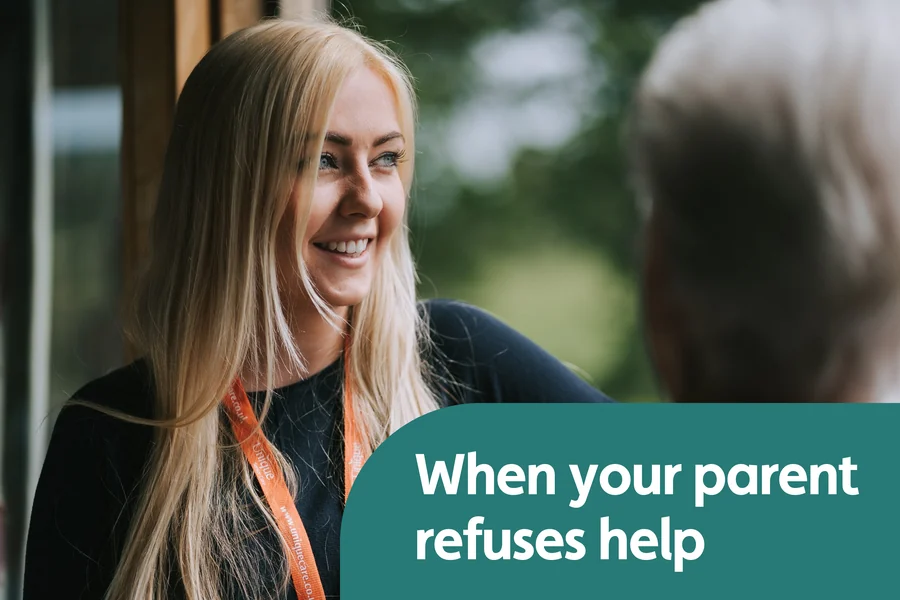
It can be heartbreaking to see your mum or dad struggling with things that used to come easily, especially when every offer of help is met with a firm “no”. You might be worried about falls, missed medication, meals, personal care or simply whether they are coping when you are not there and when you’re the one picking up the pieces, it can be difficult to know how far to push.
There is rarely one conversation that suddenly changes everything. When you’re wondering what to do when elderly parents refuse help, it is usually more useful to understand why they are saying no, keep them involved in decisions and look for the smallest step they might be comfortable accepting.
If you are still at the earlier stage of working out whether your parent needs more support at all, our guide to what to do when a parent needs care may be a better place to start.
Contents
- Start by finding out what “no” really means
- How to talk to elderly parents about accepting help
- What to do when an elderly parent still refuses help
- What if Mum or Dad has capacity but still says no to care?
- When to ask for help if you are worried about capacity
- How to respond when a parent with dementia refuses help
- How to balance independence with genuine safety concerns
- What if you cannot keep providing all the help yourself?
- How to introduce home care without it feeling like a takeover
Start by finding out what “no” really means
When a parent refuses help, it’s easy to hear it as a refusal of the practical thing you are suggesting. But often there is something else underneath it.
They might be worried that accepting help means losing their independence. They may feel embarrassed about needing support with personal things. They might be frightened that agreeing to a little help now will eventually mean leaving their home.
Sometimes the concern is much simpler. They don’t want a stranger coming into the house, they are worried about the cost, or they genuinely do not feel they need as much help as you think they do.
Before trying to persuade them, it can help to ask what is bothering them about the idea.
You could try questions such as:
- “What is it about having some help that you don’t like?”
- “What are you most worried might change?”
- “What would make this feel more comfortable for you?”
- “Is there any kind of help you would be happier with?”
You may not get a clear answer straight away. But understanding the objection gives you something much more useful to work with than simply repeating the same suggestion.
How to talk to elderly parents about accepting help
Try not to make the conversation about everything they can no longer do. Even when your concerns are completely reasonable, hearing a list of problems can make somebody feel as though decisions are being made about them rather than with them. Instead, start with what matters to your parent.
If staying at home is their priority, for example, you can talk about help as something that could make staying at home easier. If they hate relying on you for shopping or lifts, support could give them back some independence rather than take it away.
It can also help to focus on one specific issue rather than introducing “care” as one big change.
That might mean talking about:
- some help with cleaning or meals
- support getting washed and dressed
- someone being there while they take a shower
- help getting out to appointments or activities
- a little company during the week
The aim is simply to find out whether there is a version of support your parent feels able to say yes to.
If you haven’t yet had the conversation at all, we have a separate guide on how to start the care conversation with elderly parents. This article is more about what happens when you have already raised the subject and the answer is still no.
What to do when an elderly parent still refuses help
If you’ve listened to their concerns, explained why you are worried and your parent still refuses help, try to avoid turning every visit or phone call into another attempt to persuade them.
Instead, think about the smallest next step. Could they meet somebody without agreeing to care? Would they accept help with one particular task? Could you arrange an assessment so everybody has a clearer picture of what support might be useful?
Sometimes a parent is also more receptive when the suggestion comes from somebody outside the immediate family. Their GP, another health professional, social care professional or somebody else they trust may be able to raise the same concern without the emotional history that inevitably comes with family conversations.
It can help to think of the next step like this:
What if Mum or Dad has capacity but still says no to care?
This is often the hardest part for families. If your parent has the mental capacity to make a particular decision, they are generally entitled to make that decision even if you, other relatives or professionals think it is unwise.
Mental capacity is about whether somebody can make the specific decision in question. It is not simply about whether they have dementia, whether they’re forgetful or whether you agree with the choice they’ve made.
Under the Mental Capacity Act, a person should not be treated as unable to make a decision simply because they make a decision other people consider unwise. GOV.UK explains more about how mental capacity is assessed.
That can leave families in an uncomfortable position, as you may be able to see risks that your parent is willing to accept.
You can still explain your concerns, offer alternatives and make it easier for them to accept help later. But if they understand the decision and its consequences, respecting their choice is part of respecting their autonomy.
When to ask for help if you are worried about capacity
If you’re genuinely unsure whether your parent can understand or weigh up a particular decision, it is reasonable to ask for professional advice.
Capacity can depend on the decision being made and can sometimes fluctuate. Somebody may be perfectly able to decide what they want for lunch but struggle with a more complicated decision involving care, finances or significant risks.
A GP, social care professional or another appropriate health professional may be involved depending on the circumstances. The important distinction is that refusing help does not, by itself, mean somebody lacks capacity.
This can be a useful way of thinking about which route you are dealing with:
How to respond when a parent with dementia refuses help
Dementia can make these conversations more complicated, but a diagnosis of dementia does not automatically mean somebody can’t make their own decisions.
Some people living with dementia may also have difficulty recognising changes in their own abilities. This is sometimes described as a lack of insight. The Alzheimer’s Society explains more about denial and lack of insight in dementia.
If your parent insists they’re managing perfectly well when you are seeing clear signs that they are not, repeatedly confronting them with evidence can sometimes make the conversation more upsetting.
Instead, focus on the outcome you are trying to achieve. Rather than saying, “You can’t cook safely anymore, so you need a carer,” you might talk about having somebody around to help with lunch or make the day a little easier.
Familiarity can be important, too. If support is introduced, having a consistent person and allowing time for a relationship to develop can feel very different from a succession of unfamiliar faces coming into the home.
If you’re looking specifically at support for somebody living with dementia, you can also read about our dementia care at home.
How to balance independence with genuine safety concerns
Families often find themselves trying to balance two things that both matter: respecting a parent’s independence and making sure genuine risks are not ignored.
Not every risk needs to be removed. Most of us make choices every day that involve some degree of risk. But if you’re seeing repeated falls, serious problems with medication, unsafe use of appliances, significant self-neglect or another substantial concern, it may be time to involve professionals rather than trying to manage everything within the family.
You can ask your local council for a care needs assessment. This looks at the person’s day-to-day needs and may identify support such as practical help at home, equipment or adaptations, depending on their circumstances.
If there is an immediate medical emergency, call 999. If you believe an adult is at risk of abuse or neglect, contact the adult safeguarding team at their local council.
What if you cannot keep providing all the help yourself?
Your parent’s right to make their own choices does not mean you have to provide unlimited care yourself.
This can be particularly difficult when a parent refuses outside help because they assume you’ll continue doing the shopping, cleaning, personal care, medication reminders, appointments and everything else that has gradually fallen to you.
It is reasonable to be honest about what you can and cannot continue doing. That might mean saying something like, “I can still come over twice a week, but I can’t manage every morning before work anymore. We need to think about another way of getting you some help on those days.”
If you provide unpaid care for somebody, you can also ask your local council for a Carer’s Assessment. This is separate from the assessment of your parent’s needs and looks at how caring affects you and what support you may need.
Setting a boundary isn’t the same as abandoning somebody. Sometimes being clear about what the family can realistically sustain is what makes it possible to have a more practical conversation about other support.
How to introduce home care without it feeling like a takeover
If your parent is open to trying some support, it doesn’t have to begin with a dramatic change. For some families, a small amount of hourly care is enough to take pressure off the areas that are becoming difficult. That could be support with getting ready in the morning, meals, medication, getting out of the house or simply having some regular company.
For somebody who needs much more support throughout the day but wants to remain at home, live-in care may be another option to explore.
Whichever type of care is being considered, involve your parent wherever you can. Let them talk about the routines that matter to them, what they want help with, what they do not want help with and the kind of person they would feel comfortable having in their home.
At Unique Senior Care, we carefully match Caregivers with the person they are supporting. For somebody who has been reluctant to accept help, that relationship can be particularly important. Care should feel like support around the life they already have, rather than somebody arriving and taking control of it.
You do not have to solve everything in one conversation
If your elderly parent refuses help today, it does not necessarily mean they will refuse every form of help forever.
Sometimes people need time to get used to the idea. Sometimes a particular event changes how they feel, or the breakthrough is simply finding a type of support that feels acceptable rather than threatening.
Keep the conversation open where you can and be clear about genuine concerns, but keep listening too. If your parent has capacity, always involve them in the decisions that affect their life. If you’re worried that they may not be able to make a particular decision safely, ask for professional advice rather than trying to make that judgement alone.
And remember that your needs matter too. You can support somebody without promising to do everything yourself.
If your parent is refusing help and you are not sure what to suggest next, you can talk the situation through with one of our Care Managers. They can listen to what is happening, explain what support could realistically look like and help you think about a first step your parent may feel more comfortable with.
- GOV.UK: Checking mental capacity
- GOV.UK: Apply for a needs assessment by social services
- GOV.UK: Carer’s Assessment
- Alzheimer’s Society: Understanding denial and lack of insight

With over 40 years of experience in the care industry, providing outstanding care has always been Helena’s core mission.
Helena has been a dedicated member of Unique Senior Care for eight years, starting as Care Manager and advancing to Head of Extra Care and now serving as Director of Operations.
She holds a Level 5 Diploma in Leadership for Health and Social Care and Children and Young People’s Services (England), as well as a Diploma in Welfare Services. Helena has completed various leadership and management courses, enhancing her expertise in the care industry.
Helena has authored published articles, including one for Skills for Care on managing change through the COVID pandemic. She has a steadfast commitment to advocating for and supporting those in need, ensuring their voices are heard and their rights upheld.