

Summary: When choosing a home care provider, ask about CQC regulation, Caregiver recruitment and training, personalised care planning, continuity, backup cover, safety, charges, quality monitoring and Caregiver matching. A good provider should answer clearly, explain how their processes work in practice and give you time to decide without pressure. This guide covers the 10 key questions to ask, what reassuring answers look like and the warning signs to watch for.

Contents
- Question 1: What types of care do you provide, and where?
- Question 2: How do you create a personalised care plan?
- Question 3: How are your Caregivers employed, vetted and trained?
- Question 4: Will my loved one see the same Caregiver regularly?
- Question 5: What happens when our regular Caregiver is unavailable?
- Question 6: How do you keep my loved one safe at home?
- Question 7: Is the home care provider CQC regulated?
- Question 8: What are your charges, and what do they cover?
- Question 9: How do you monitor care quality and handle concerns?
- Question 10: How do you match my loved one with the right Caregiver?
- One final question worth asking
- Free home care provider comparison guide
- How to choose a home care provider after asking these questions
- Choosing home care for an older parent
- Take your time choosing the right home care provider
Finding the right home care provider can feel overwhelming, especially if this is the first time you've had to think about care. There are lots of providers, they can sound very similar at first, and it is not always obvious what separates one from another.
The good news is that a few well-chosen questions can tell you a lot, depending on how the provider responds. Clear, specific and honest answers are reassuring. Evasive answers, pressure to decide quickly, or difficulty explaining how care works in practice are worth paying attention to.
This guide walks you through 10 of the most important questions to ask a home care provider. We've also included what a reassuring answer may sound like, the warning signs to look out for and a free comparison guide you can use to make notes and compare different providers side by side.
Question 1: What types of home care do you provide, and where are those services available?
It sounds obvious, but it is worth asking directly. Not every provider offers every type of care, and not every service is available in every area. Finding out there is a gap after you've already spent time discussing your needs can be frustrating.
Home care broadly includes:
- Hourly visiting care — a Caregiver visits once or several times a day to provide support with personal care, medication, meals, mobility, household routines or companionship.
- Live-in care — a Caregiver lives in the home, providing ongoing support and companionship as an alternative to moving into residential care.
Some providers specialise in one form of care. Others offer several options but only in certain areas. Ask whether the provider can also support more specialist needs, such as dementia care, Parkinson's care or complex care.
It is also worth thinking ahead. You might only need a few visits each week now, but your loved one's needs may increase later. Ask whether the provider can adapt the care without forcing you to start again with a completely different organisation.
A reassuring answer
The provider can clearly explain what care it offers in your area, what it does not provide and how support could change if your loved one's needs increase.
A warning sign
The provider promises it can meet every possible need without first understanding your loved one's circumstances.
Question 2: How do you create a personalised care plan, and how often is it reviewed?
A good care plan shouldn't feel like a standard form that is filled in and forgotten. It should reflect the person receiving care, including their health, preferences, routines, risks, strengths and what matters most to them.
Ask how the initial care needs assessment works. Who carries it out? Will they meet your loved one? Can family members contribute where appropriate? How are risks in the home assessed?
A telephone conversation can be a useful first step, but for ongoing personal care you should understand how the provider will properly assess your loved one's needs, routines and home environment before care begins.
A personalised care plan should also cover the details that make someone who they are. That might include:
- how they like to start their morning
- food and drink preferences
- hobbies and interests
- communication needs
- cultural or religious practices
- mobility and medication needs
- what they prefer to do independently
- what tends to make them anxious, comfortable or settled
Equally important is what happens afterwards. Needs change, sometimes gradually and sometimes suddenly. Ask how often formal reviews take place, who is involved and what happens if you or the Caregiver notice a change before the next scheduled review.
What happens if care needs change?
It is worth asking this directly rather than assuming the original care plan will simply continue. If your loved one becomes less mobile, starts needing more help with medication or needs additional support following an illness or hospital stay, how quickly can the provider respond?
Ask whether the provider can reassess the care plan, increase or change the support where needed and, where appropriate, coordinate with GPs, district nurses or other healthcare professionals involved in your loved one's care.
A reassuring answer
The provider explains who will assess your loved one, how they will be involved, when the care plan will be reviewed and how support can adapt if their needs change.
A warning sign
The care plan sounds fixed, generic or focused only on a list of tasks rather than the person receiving care.
Question 3: How are your Caregivers employed, vetted and trained?
This is one of the most important areas to understand because different home care arrangements can place responsibility in different places.
A regulated home care service providing personal care has an ongoing role in managing and directing that care. Introductory agencies work differently: they may introduce a family to an individual carer without continuing to manage the personal care being provided.
Rather than assuming every arrangement works in the same way, ask exactly:
- Who employs or contracts with the Caregiver?
- Who checks their suitability before they begin?
- Who trains and supervises them?
- Who provides support if the Caregiver has a problem?
- Who arranges cover if they are unavailable?
- Who is responsible for managing the quality and safety of the care?
For any provider employing Caregivers, ask specifically:
- Do you directly employ your Caregivers?
- What does your vetting process involve?
- Do you carry out enhanced DBS checks where appropriate?
- Do you obtain references and complete right-to-work checks?
- What training must Caregivers complete before supporting clients?
- What ongoing training and competency checks take place?
- How are Caregivers supervised and supported after they start?
A good provider should be comfortable answering these questions in detail. Vague statements such as "everyone is fully checked" are less useful than a clear explanation of what those checks actually involve.
At Unique Senior Care, we directly employ our Caregivers. Before supporting clients, they complete our recruitment and vetting process and undertake induction and training through our in-house training academy, covering areas including safeguarding, first aid, medication and person-centred care.
A reassuring answer
You receive a specific explanation of recruitment checks, training, ongoing supervision and who remains accountable for the care.
A warning sign
It is difficult to work out who actually manages the Caregiver or who would take responsibility if a concern arose.
Question 4: Will my loved one see the same Caregiver regularly, or will it change from visit to visit?
Consistency matters more than many families realise until they experience the alternative. When someone regularly sees the same Caregiver or small team, relationships can develop naturally. Their Caregivers learn their preferences, their routines, how they communicate and what is normal for them.
That familiarity can also make changes easier to notice. Someone who knows your loved one well may pick up on a change in mood, appetite, confidence or mobility that a different person on every visit could miss.
Continuity can be particularly important for someone living with dementia. An unfamiliar person arriving at the house may cause anxiety or confusion, while a familiar Caregiver can make the visit feel more predictable.
Ask directly:
- How many different Caregivers might my loved one see in a normal week?
- Do you work with small, consistent Caregiver teams?
- What happens if my loved one does not feel comfortable with a particular Caregiver?
A reassuring answer
"We aim to give each client a small team of regular Caregivers so they can get to know one another properly."
A warning sign
The provider cannot tell you roughly how many different people may visit or treats continuity as unimportant.
Question 5: What happens when our regular Caregiver is unavailable - who steps in, and how will we know?
Even the most reliable Caregiver will occasionally be ill, take annual leave or be unavailable. What's important is whether the provider has planned for it.
Ask who is likely to step in when your usual Caregiver cannot attend. Ideally, your loved one will already know the replacement because they are part of a small regular team.
It is also worth asking:
- How is backup cover arranged?
- Will a visit ever be cancelled because a Caregiver is unavailable?
- How much notice will we receive about a change where possible?
- How will you tell us who is coming instead?
- Will the replacement Caregiver have access to the current care plan and relevant information?
We aim to give clients a small team of regular Caregivers for exactly this reason. If the usual Caregiver is away, another Caregiver who already knows the client may be able to provide cover without the family having to explain everything again.
A reassuring answer
The provider has an established cover process and tries to use Caregivers who already know your loved one.
A warning sign
The answer is simply "we'll send someone" with no explanation of how cover, communication or continuity is managed.
Question 6: How do you approach safety at home, and what happens if something goes wrong?
Home safety covers everything from managing medication and safeguarding to responding to changes in health, emergencies, risks in the home and how Caregivers report concerns.
Some specific things worth asking about include:
- Medication management - are Caregivers trained in safe medication administration, and how is medication support recorded?
- Emergency response - what should a Caregiver do if they arrive and believe something is seriously wrong?
- Risk assessment - how are risks such as falls, mobility issues and environmental hazards assessed?
- Safeguarding - what training do Caregivers receive and how are safeguarding concerns escalated?
- Incident reporting - how are incidents documented and who is informed?
- Changes in condition - what happens if a Caregiver notices that someone appears more confused, unwell or unsteady than usual?
- Care management technology - are visits and notes recorded electronically, and can family members access appropriate updates?
A good provider should be able to describe these systems clearly rather than relying on vague assurances that Caregivers "know what to do".
A reassuring answer
The provider can clearly explain how risks are assessed, how medication and incidents are recorded, what Caregivers should do in an emergency and how concerns are escalated.
A warning sign
The provider relies on vague assurances that Caregivers "know what to do" but cannot explain its processes for emergencies, medication, incident reporting or safeguarding concerns.
Question 7: Is the home care provider CQC regulated, and what is its current rating?
If the provider is delivering a regulated activity such as personal care in England, checking its Care Quality Commission registration is one of the most important checks you can make.
The Care Quality Commission (CQC) is the independent regulator of health and adult social care in England. CQC assesses services using five key questions: whether they are safe, effective, caring, responsive and well-led.
Under its current assessment framework, CQC uses quality statements to describe what good care looks like and gathers evidence to assess quality and performance. Ratings can be Outstanding, Good, Requires Improvement or Inadequate.
Do not rely only on a badge on a provider's website. Search for the service yourself and look at:
- whether the service is registered for the regulated activity it provides
- its current published rating, where one has been awarded
- the date of the latest assessment or inspection information
- the individual ratings or findings beneath the overall result
- any areas CQC has said need improvement
You can search for a provider and read its published information using the CQC's Find and compare care services tool.
Unique Senior Care's Kenilworth and Solihull locations currently hold CQC Outstanding ratings, while our Warwickshire service holds a Good rating. You can find further information about our services and ratings on our CQC page.
A reassuring answer
The provider openly tells you which service is registered, encourages you to check CQC yourself and is willing to discuss the published findings.
A warning sign
The provider is vague about CQC registration or discourages you from looking at its published information yourself.
Question 8: What are your charges, what do they cover, and are there any additional costs?
Home care costs vary between providers, and the headline rate does not always tell you the full story. Some providers charge differently for bank holidays, weekends or certain visit lengths. Others may have separate care management or administration costs.
Ask for a clear, written breakdown covering:
- the hourly rate or weekly live-in care rate
- whether rates differ for evenings, weekends or bank holidays
- whether there are travel or mileage charges
- what care management and coordination are included
- whether there is a minimum visit length or minimum number of hours
- the cancellation policy
- notice periods if you want to stop or change the service
- what happens to the cost if care needs increase
Do not be afraid to ask for examples. For instance: "If Mum had one hour of care every morning and evening, seven days a week, what would the total weekly cost be?" A provider should be able to help you understand what you would actually pay.
It is also worth asking what financial support may be available. Depending on your loved one's needs and circumstances, this could include local authority support following care and financial assessments, NHS Continuing Healthcare or disability-related benefits.
For someone who has reached State Pension age and needs help with personal care or supervision because of a health condition or disability, Attendance Allowance may be relevant. Personal Independence Payment may apply in other circumstances, particularly where someone became eligible before reaching State Pension age.
A home care provider cannot decide whether you are eligible for these forms of support, but a helpful provider should be able to signpost you towards reliable information. Our guide to funding care at home explains the main routes in more detail.
Our pricing is designed to be clear, with care and ongoing Caregiver support explained upfront. You can see a full breakdown on our home care costs page or get an indication using our home care costs calculator.
A reassuring answer
You receive the costs in writing and can clearly see what is included, what may cost extra and what notice terms apply.
A warning sign
You are given only a headline price and cannot get a straightforward answer about additional charges or cancellation terms.
Question 9: How do you monitor the quality of care, involve families and handle concerns or complaints?
Knowing that care appears good when you're there is one thing. Knowing that the same standard is maintained when you're not there is another.
Ask what quality monitoring looks like in practice:
- How often does a Care Manager check in with the client?
- How often are care plans reviewed?
- How are Caregivers supervised and supported?
- Are competency checks or observations carried out?
- How do you gather feedback from clients and families?
- How do you identify patterns or recurring problems?
- How can family members stay involved, where the person receiving care wants them to?
How will you keep family members informed?
For many families, especially those who do not live nearby, communication is a big part of feeling confident about care.
Ask whether there will be a named person you can contact, how regular updates are handled and what happens if circumstances change. For example, who will contact you if a Caregiver notices a significant change in your loved one's wellbeing, or if there is a change to the planned visit?
It is also worth asking whether the provider uses a digital care system that allows appropriate family members to see visit information or updates. Any information-sharing should, of course, respect the wishes, consent and privacy of the person receiving care.
A reassuring provider should be able to explain:
- who your main point of contact will be
- how and when updates are provided
- how families are informed when circumstances change
- how urgent concerns are communicated
- how the client's preferences around family involvement are recorded and respected
You should also ask what happens when something is not right. No provider can promise that a concern will never arise. What matters is how seriously and transparently they respond.
Questions to ask about complaints and concerns
- Who should I contact if I am unhappy with the care?
- Is there a named person responsible for dealing with concerns?
- What is your complaints procedure?
- How quickly should I expect a response?
- How are complaints investigated?
- How will I know what action has been taken?
- What can I do if I am still unhappy with the outcome?
A provider who takes quality seriously should not become defensive when you ask these questions. They should be able to explain how feedback, incidents and complaints are used to improve care.
At Unique Senior Care, clients and families can be involved through regular reviews, feedback and ongoing conversations with the care team. Our client stories give a sense of how families experience that support in practice.
A reassuring answer
There is a clear review, supervision, communication and complaints process, and you know who to contact if you are concerned.
A warning sign
The provider talks about having "happy clients" but cannot explain how quality is monitored, how families are kept informed or what happens when somebody complains.
Question 10: How will you match my loved one with the right Caregiver?
The practical side of care matters enormously. But so does whether your loved one feels comfortable with the person coming into their home.
A good provider should take time to understand the person before deciding who may be a suitable Caregiver. That means looking beyond the care tasks to things such as:
- personality and communication style
- interests and hobbies
- preferred routines
- language preferences
- cultural or religious considerations
- experience with particular health conditions
- whether someone enjoys conversation or prefers a quieter presence
Ask how the matching process works. Is the decision made by someone who has actually spoken with your loved one? What happens if the match does not feel right?
A well-matched Caregiver is not simply someone who can complete the required tasks. They are someone your loved one feels comfortable welcoming into their home.
A reassuring answer
The provider asks about your loved one's personality and preferences and has a clear process if the first match does not feel right.
A warning sign
Matching appears to be based entirely on who is available rather than who is likely to suit the person receiving care.
One final question worth asking: what makes your service different from other home care providers?
Most home care providers will tell you they offer high-quality, person-centred care. Those things matter, but they can be difficult to compare when every provider uses similar language.
Asking "What makes your service different from other home care providers?" encourages them to explain what their approach looks like in practice.
Listen for specific examples rather than general claims. They might talk about:
- how they maintain consistency of Caregivers
- how Caregivers are trained and supported
- how carefully they match clients and Caregivers
- how involved Care Managers remain once care has started
- how quickly they can adapt when someone's needs change
- how they communicate with clients and families
There is no single correct answer. What matters is whether the provider can explain its approach clearly and whether the things it values are the things that matter to you and your loved one.
Take these questions with you and compare providers side by side
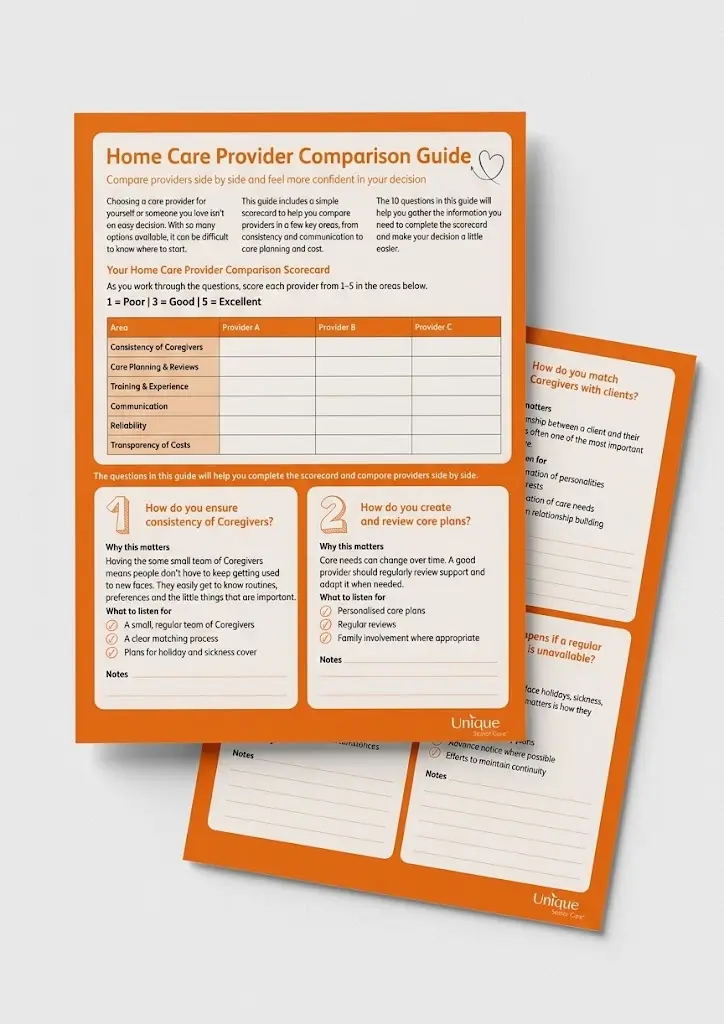
It can be difficult to remember everything when you're speaking to several care providers. Our free Home Care Provider Comparison Guide gives you questions to ask, space to make notes and a simple scorecard for comparing up to three providers.
Use it to compare Caregiver consistency, care planning, training, communication, reliability and costs, so you do not have to rely on memory when it is time to make a decision.
How to choose a home care provider after asking these questions
Once you've spoken to a few providers, you may still be left with two or three that seem suitable. At that point, try to compare more than their brochures or hourly rates.
Look at the whole picture:
1. Check independently
Look up the provider's CQC registration and published information yourself.
2. Compare like for like
Ask each provider the same core questions. Make notes as you go and compare their answers afterwards rather than trying to remember who said what.
3. Look beyond availability
Consider Caregiver continuity, training, supervision, communication and backup arrangements as well as whether care can start quickly.
4. Notice what they ask you
A provider should be interested in your loved one's routines, preferences and goals, not only in filling available care hours.
5. Pay attention to communication
How responsive and clear is the provider before you've signed anything? That can tell you something about what communication may be like later.
6. Give yourself time
Unless care is urgently needed, you should feel able to ask further questions, compare your notes and think before committing.
A comparison scorecard can help organise what you have learned, but do not choose on numbers alone. Think about which provider gave you clear answers, listened properly and left you and your loved one feeling most confident.
The cheapest provider is not automatically the wrong choice, and the most expensive is not automatically the best. What matters is whether the service is safe, suitable, transparent and able to provide the kind of consistent support your loved one needs.
Choosing home care for an older parent: involve them wherever possible
If you're choosing home care for an older parent, it is easy to feel that the responsibility rests entirely with you. You may be researching providers, arranging calls and trying to make sense of costs while also worrying about whether Mum or Dad is coping at home.
But wherever possible, the person receiving care should remain at the centre of the decision.
Questions to ask your parent before choosing care
- What would you actually like help with?
- What do you still want to do independently?
- What time of day would you prefer someone to visit?
- What would make you feel comfortable with a Caregiver?
- Is there anything you definitely do not want?
- Would you like to meet the Caregiver before care begins?
These conversations are not always easy. Your parent may be worried that accepting help means losing independence. In practice, well-planned home care should support them to keep doing what they can for themselves, while providing help where it makes life safer or less tiring.
Try to avoid talking about care as something being "done to" them. Instead, focus on what support could make easier: staying at home, keeping familiar routines, getting out, eating well, managing medication safely or reducing the pressure on family relationships.
Take your time choosing the right home care provider
Choosing a home care provider is a big decision, and it is worth speaking to more than one before making up your mind.
How each provider handles your questions tells you a lot. Notice the clarity of their answers, whether they are open about how things work, whether they are willing to discuss costs and problems as well as positives, and whether they take the time to understand the person who will actually receive the care.
You do not need to know everything about home care before making the first call. You simply need enough information to ask sensible questions and the confidence to keep asking until the answers make sense.
Would it help to talk your options through?
If you're trying to work out what kind of care would suit your loved one, our team is happy to talk through your situation and answer your questions without pressure or obligation.
Call 0186 550 7002 or get in touch through our contact page.
External references
- Care Quality Commission: Find and compare care services
- Care Quality Commission: Assessment framework
- Care Quality Commission: Personal care, introductory agencies and individual care workers
- UK Government: Disclosure and Barring Service
- UK Government: Attendance Allowance
- Age UK: Arranging home care
Unique Senior Care is a CQC-regulated home care provider delivering visiting care, respite care and live-in care. Our Kenilworth and Solihull locations currently hold CQC Outstanding ratings.

With over 40 years of experience in the care industry, providing outstanding care has always been Helena’s core mission.
Helena has been a dedicated member of Unique Senior Care for eight years, starting as Care Manager and advancing to Head of Extra Care and now serving as Director of Operations.
She holds a Level 5 Diploma in Leadership for Health and Social Care and Children and Young People’s Services (England), as well as a Diploma in Welfare Services. Helena has completed various leadership and management courses, enhancing her expertise in the care industry.
Helena has authored published articles, including one for Skills for Care on managing change through the COVID pandemic. She has a steadfast commitment to advocating for and supporting those in need, ensuring their voices are heard and their rights upheld.


