Summary: Some people with dementia genuinely do not realise they have dementia. While families often assume this is denial, changes in the brain can affect a person's ability to recognise their own difficulties, a symptom known as a lack of insight. This can make conversations about memory problems, support, driving and safety particularly challenging. In this article, we explain why this happens, how it differs from denial, why arguing rarely helps, and practical ways to support a loved one while protecting your relationship and your own wellbeing.
If you're caring for someone with dementia, there's a good chance you've had some version of this conversation. You raise a concern. Maybe it's about the forgotten appointments, the gas left on, the same story told four times in one afternoon. And the person you love looks at you, perhaps a little hurt, perhaps a little cross, and says: "I'm absolutely fine. I don't know why you keep going on about it."
And you're left standing there, exhausted and confused, wondering whether they're being deliberately awkward, whether they're in denial, or whether something else entirely is going on.
The thing is, it's likely to be none of those things. It might actually be the dementia itself.
Why someone might not know, or accept, that they have dementia
There's a medical term for this that you might not have come across: anosognosia. It sounds very clinical, but in plain English it simply means that the brain can lose its ability to notice what it's lost. Not because someone is being difficult. Not because they're scared and pretending. But because the part of the brain that would normally flag up "something isn't right here" has itself been affected by the condition.
Think of it this way. If you broke your arm, you'd know about it immediately. But some types of brain change can affect the very systems we rely on to notice that something is wrong. Researchers describe it as a failure in the brain's error-monitoring (the mechanism that normally updates our sense of ourselves when things aren't working the way they used to). When that system is disrupted, a person may genuinely not register their mistakes or revise their self-image in light of new difficulties. It's not a choice. It's a symptom.
Dementia doesn't just affect memory. It can affect judgment, understanding, language, and crucially, the ability to have insight into your own situation. So when your dad insists he's driving perfectly well, or your mum can't understand why you're fussing about her taking the wrong medication, it's quite possible that, from where they're sitting, everything genuinely does feel fine.
Research published in 2026 looked at how carers, clinicians and home support workers experience this, and found that three in four of them came across a lack of awareness in the people they cared for often or extremely often. The same research linked it to delayed diagnosis, delayed support, repeated disagreements at home, safety concerns, and in some cases the complete breakdown of care. It's incredibly common, and yet it remains one of the hardest things for families to get their heads around.
Is it denial, or do they genuinely not realise they have dementia?
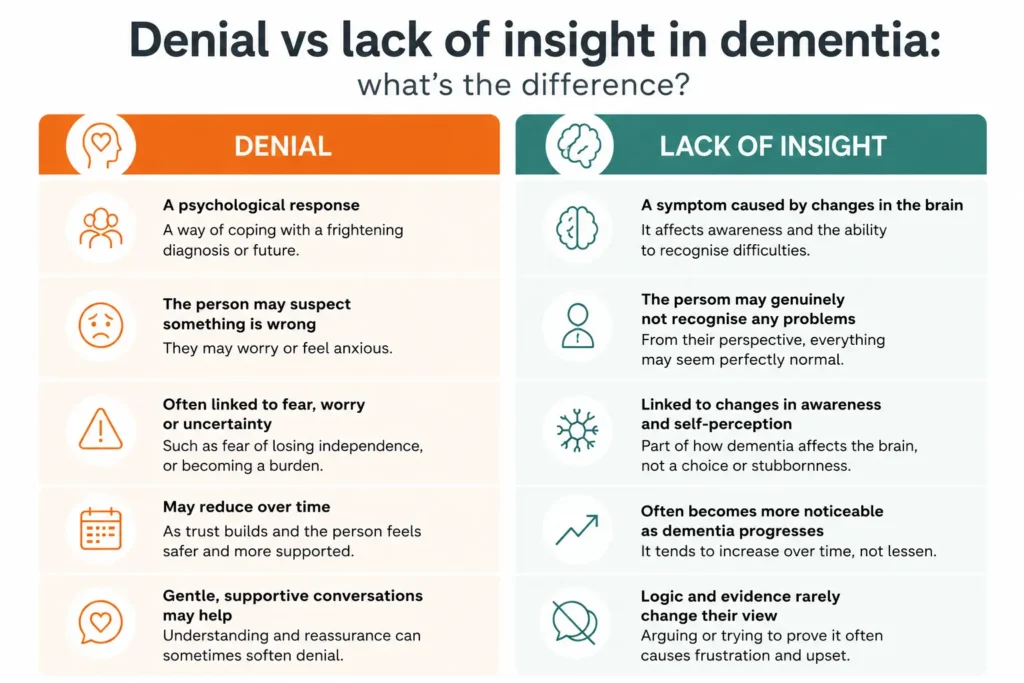
Sometimes yes, it may be denial, but it's really worth understanding the difference, because how you respond to each is quite different.
Denial is a psychological thing. It's a human defence mechanism. When the diagnosis is frightening, when the future feels threatening, when there's stigma involved or a real fear of losing independence — it makes complete sense that someone would resist accepting it. Common drivers include fear of losing their driving licence, worry about becoming a burden, shame around memory problems, or simply not understanding what dementia actually means for their life. This can be especially strong in people with younger onset dementia, or in rarer conditions where memory loss isn't the first symptom.
Lack of insight is neurological. It's what happens when the physical changes in the brain, particularly in the frontal lobes, genuinely reduce someone's awareness of their own difficulties. Dementia UK and the Alzheimer's Society both explain that this tends to get more pronounced as the condition progresses, not less. It's more common in frontotemporal dementia but can happen with any type.
Here's a practical clue researchers have identified: someone in denial will often seem anxious, defensive, or upset when you raise the topic because, on some level, they do know and it frightens them. Someone with genuine lack of insight may seem almost unbothered. A bit baffled that you're worried. Relatively calm about the whole thing, in a way that can feel surreal or even hurtful to the people around them.
This is important to note when it comes to how you respond. Denial may soften over time, especially if conversations feel safe, gentle and non-shaming — there's a chance the person may gradually come to accept more help as trust builds. Genuine lack of insight, though, is much less likely to shift through logic, evidence or repeated explanation. Trying to argue someone out of it doesn't just fail, it tends to make things actively worse, because you're essentially attacking a reality they're not able to question.
And sometimes? It's a bit of both at once. Someone might half know something is wrong but still push it away because the full truth feels too much to sit with. The evidence doesn't support a neat either/or, and you don't need to diagnose which one you're dealing with before you can respond with kindness.
How dementia affects awareness, judgement and behaviour, not just memory
One of the most persistent misconceptions is that dementia is basically about forgetting things. For some people, that's true in the early stages. But for some people, especially those living with frontotemporal dementia, memory problems aren't always the first sign. Instead, families may notice changes in personality, behaviour, social awareness or language long before memory is affected. Because these changes can be subtle, and because the person may have no awareness of them at all, families can spend months or even years wondering if they're imagining things.
This is also partly why some people with dementia can hold a perfectly lucid-sounding conversation in a short GP appointment, then struggle badly at home. Symptoms can fluctuate significantly depending on tiredness, stress, infection or simply the time of day. It can be bewildering for families, and can make the whole process of getting support feel like an uphill battle. The NHS and NICE both note that getting a proper picture often requires input from someone who knows the person well and not just what the person themselves reports in a clinical setting.
One important note: if someone with dementia suddenly becomes much more confused than usual, over hours or a day or two rather than gradually, that's worth getting checked out medically as soon as possible. Infections, dehydration, constipation and medication changes can all cause a sudden, sharp dip that looks like the dementia getting worse but may be something treatable.
What to do when someone with dementia doesn't accept their diagnosis
This is where a lot of families feel stuck, because the instinct is to keep trying to get through. To find the right words. To finally make them see it.
But every major dementia organisation is pretty clear that you almost certainly can't argue someone into accepting a diagnosis. And trying to tends to make things harder, not easier. It can feel humiliating to the person, it erodes trust, and it makes future conversations about GP visits, medication or getting some help at home even more fraught. The 2026 research is blunt about it too: there is no indication that pushing someone to acknowledge their dementia or their symptoms is helpful. In fact, greater awareness of difficulties often comes with more sadness and worry about the future — so forcing the issue isn't automatically kinder either.
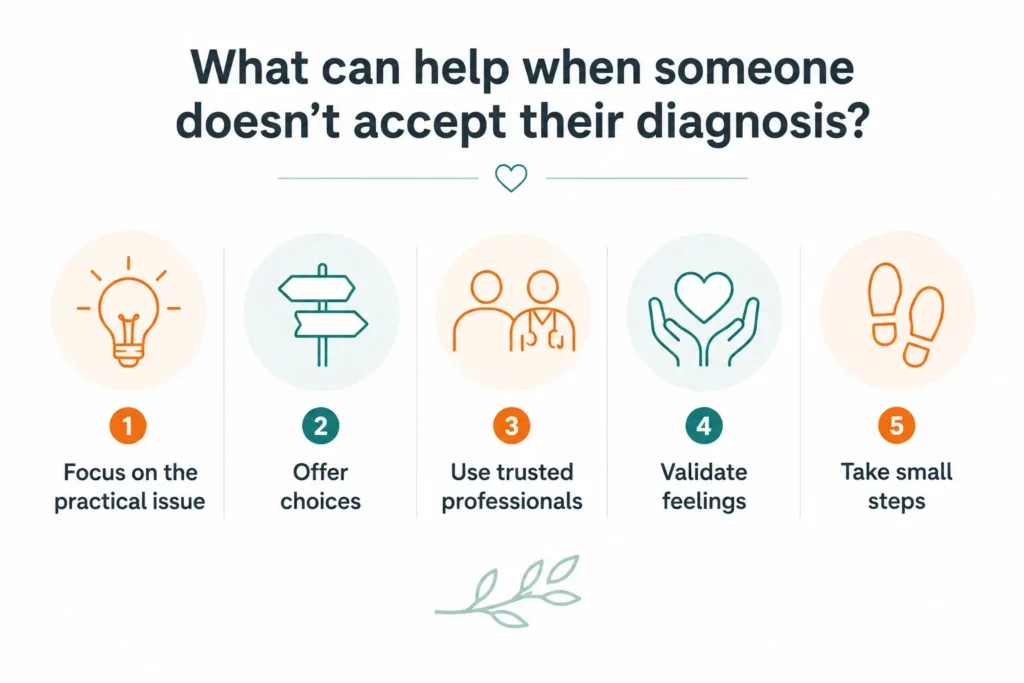
What tends to work much better is stepping away from the diagnosis entirely and focusing on the practical difficulty in front of you. Here's what that actually looks like:
- Talk about the specific problem, not the label. Rather than "you have dementia and you need help", try something like: "I've noticed you've seemed a bit worn out lately — would it help to have someone come in a couple of mornings a week?" or "The garden's getting a bit much, shall we look at getting someone in?" You're not being dishonest. You're just not making the conversation about winning an argument you can't win.
- Focus on what they gain, not what they're losing. This matters enormously. If driving is becoming unsafe, don't frame it as taking the keys away — talk about not having to deal with parking, saving money on petrol and insurance, or being able to have a glass of wine at Christmas dinner. If some support at home would help, lead with the company, the lighter load, the help with jobs they've said they find a faff. The Alzheimer's Society specifically recommends this benefit-led approach, and it works because it doesn't ask the person to admit to a problem they can't see.
- Use a third party where you can. A suggestion often carries more weight from a GP, a practice nurse, or even a trusted old friend than it does from a worried son or daughter. If someone won't accept a dementia assessment, a gentler route in is encouraging them to see the GP about how they've been feeling generally. Maybe they're more tired than usual, a bit muddled, not quite themselves. Many families find this a much easier conversation to have.
- Ring the GP yourself. Even if your loved one won't go or won't discuss it, you can contact the GP and share what you're seeing. They can't always talk back to you about the person's care without consent, but they can absolutely listen, and it means your concerns are on record.
- Validate rather than contradict. You don't have to agree with everything, but repeatedly disputing someone's version of reality does real damage to the relationship and makes future conversations harder. Experts suggest acknowledging rather than arguing. Meet people where they are, not where you need them to be.
- Try a trial run. If someone is resistant to home support, the Alzheimer's Society suggests introducing it gradually — framing it as a short trial rather than a permanent arrangement. It takes the pressure off, lets a relationship build with the carer, and often means the person comes to welcome the visits in a way they wouldn't have accepted upfront.
How to handle safety concerns when someone doesn't realise they have dementia
This is the harder conversation and, for many families, it's where things become genuinely frightening. Driving is often one of the biggest worries. Someone who has always been independent and proud of it may be completely unable to recognise that their driving has become dangerous. This is one of the most common and serious safety concerns in dementia care, and it's one where lack of insight plays a particularly cruel role because the person behind the wheel may feel entirely confident. If you're worried, your GP can refer the person for a DVLA assessment, and the DVLA can be notified directly if you have serious concerns. It's an uncomfortable step, but it's there for exactly this situation.
Other safety concerns may be things like medication, leaving the hob on, answering the door to strangers, being at home alone for long periods. Often, these need practical solutions rather than conversations. Pill dispensers with alarms, induction hobs that cut out automatically, door sensors and telecare systems can all reduce risk without requiring the person to acknowledge they need them. Framing them as useful gadgets rather than safety measures can help avoid conflict.
If you're genuinely worried about someone's safety and they're refusing all support, you don't have to manage this alone. The Alzheimer's Society advises contacting your GP or your local adult safeguarding team. And if things reach a point where someone no longer has the mental capacity to make certain decisions safely, there are legal frameworks, including the Mental Capacity Act, to help navigate that. The key thing is to get advice early, not to wait until there's a crisis.
Supporting yourself while supporting someone with dementia
Supporting someone who doesn't believe they need help can be challenging, because you can see changes happening that they may not be able to see themselves. You want to help, but your suggestions might be met with frustration, resistance or confusion. Over time, that can take its toll.
Many family carers tell us they spend a lot of time second-guessing themselves. Should I push the issue? Should I let it go? Am I doing the right thing? The truth is that there isn't a magic phrase that suddenly makes someone accept help. Some conversations will go better than others, and there will still be difficult days.
That's why it's important to make sure you're getting support too. Research shows that family carers of people living with dementia are at greater risk of depression and poor mental health. Looking after yourself isn't selfish. It's an important part of being able to support someone else.
A carer's assessment can help you access practical support, respite care and local services you may not realise are available. Your GP can also help if you're finding things difficult.
If you'd like to speak to someone who understands dementia, Dementia UK's Helpline is staffed by Specialist Dementia Nurses and can be reached on 0800 888 6678. The Alzheimer's Society's Dementia Connect Support Line is available on 0333 150 3456. Both offer free advice and support for families affected by dementia.
You may also find our Guide to Dementia Care helpful. It explains the different types of dementia, common symptoms, care options, and practical ways to support a loved one at each stage of their journey.
Download your free guide to dementia care..
Inside you’ll find clear explanations, practical tools, and step-by-step guidance to help make life easier for you and your loved one.
External references
- Dementia UK — Understanding denial and lack of insight: https://www.dementiauk.org/information-and-support/living-with-dementia/understanding-denial-and-lack-of-insight/
- Alzheimer's Society — Understanding denial and lack of insight: https://www.alzheimers.org.uk/get-support/help-dementia-care/understanding-denial-lack-of-insight
- Alzheimer's Society — Coping with denial and lack of insight: https://www.alzheimers.org.uk/get-support/help-dementia-care/coping-denial-lack-of-insight
- NHS — How to get a dementia diagnosis: https://www.nhs.uk/conditions/dementia/symptoms-and-diagnosis/diagnosis/
- NHS — Communicating with someone with dementia: https://www.nhs.uk/conditions/dementia/living-with-dementia/communication/
- NICE — Dementia: assessment, management and support (guideline NG97): https://www.nice.org.uk/guidance/ng97/chapter/Recommendations
- Dementia UK — Tips for communicating with a person with dementia: https://www.dementiauk.org/information-and-support/living-with-dementia/tips-for-communication/
- Dementia UK — Keeping safe when you care for someone with dementia: https://www.dementiauk.org/information-and-support/looking-after-yourself-as-a-carer/keeping-safe-when-you-care-for-someone-with-dementia/
- Dementia UK — Starting conversations about dementia: https://www.dementiauk.org/news/starting-conversations-about-dementia/
- Frontiers in Dementia (2026) — Care challenges related to lack of awareness in people with dementia: https://www.frontiersin.org/journals/dementia/articles/10.3389/frdem.2026.1770977/full
- PMC / Frontiers (2024) — Studying lack of awareness of cognitive decline in neurodegenerative diseases: measures of both anosognosia and denial: https://pmc.ncbi.nlm.nih.gov/articles/PMC10800930/

Jo joined Unique Senior Care as a Carer in 2011, transitioning from a nursing background. With 25 years of experience in health and social care, including mental health and children with disabilities, Jo has embraced numerous growth opportunities within the company.
Passionate about learning and development, Jo earned a Level 5 Diploma in this field and is committed to equipping teams with the skills needed for outstanding care.
Jo’s qualifications include advanced training in people handling, risk assessment, safeguarding, basic life support, first aid, health and safety, and dementia care. Jo has also completed numerous workshops and CPD courses, such as the SCIE’s Co-Production webinar.
These accomplishments reflect Jo’s dedication to fostering a culture of safety and excellence in care.