Summary: This blog explores the early signs and symptoms of caregiver burnout that families often miss, including constant exhaustion, never fully switching off, irritability and guilt, isolation, feeling trapped, declining health, and carrying care responsibilities alone. It explains why caregiver burnout develops gradually, how it affects both carers and the quality of care they can provide, and why many people do not recognise the warning signs until they reach crisis point. The article also includes practical, expert-backed advice on reducing pressure, accessing formal and community support, respite care, Memory Cafés, and small changes that can make caring feel more manageable. Written in a warm, supportive tone, the blog is designed to help unpaid carers feel understood, recognise when they need support, and take early action before burnout becomes overwhelming.
Caregiver burnout rarely starts with a breakdown. More often, the pressure slowly builds in ways that are easy to dismiss at first. Your patience feels shorter, you stop properly switching off, and small parts of your own life slowly disappear while caring takes over more and more space.
At first, many people caring for a loved one simply see these changes as part of coping with a difficult situation. You are focused on keeping someone you love safe, comfortable, and supported. You keep going because it feels like you have to.
In the video above, Jo Cleary, Learning and Development Manager at Unique Senior Care, explains that some of the earliest signs of caregiver burnout are also the easiest to miss. After more than 25 years working in health and social care, supporting families and Caregivers, Jo has seen how often people reach crisis point before realising they have been struggling for a long time.
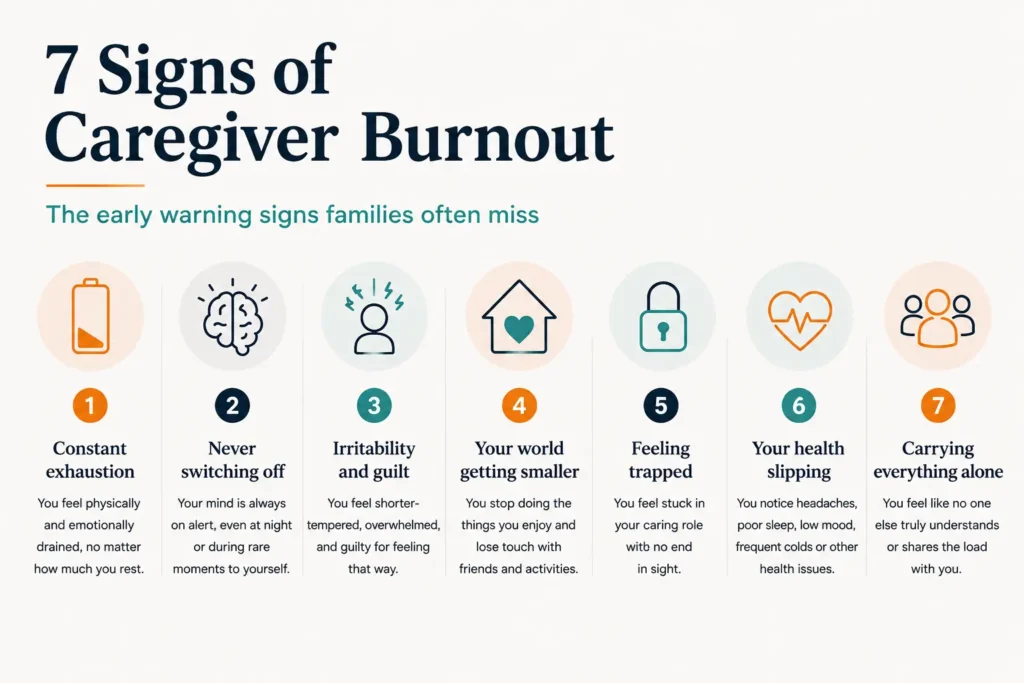
This article walks through seven signs of caregiver burnout families often overlook, why they happen, and the practical steps that can help ease pressure before exhaustion becomes overwhelming.
What is caregiver burnout?
Caregiver burnout is the physical, emotional, and mental exhaustion that can happen when someone spends a long time caring for another person without enough rest, support, or time to recover.
For many families, it builds gradually. Sleep becomes disrupted, worry becomes constant, and your own needs slowly move further down the list while caring takes up more and more emotional and physical energy.
Burnout in caregivers is extremely common, and many of the signs and symptoms of caregiver burnout become more noticeable as caring responsibilities increase over time. especially when caring responsibilities increase over time. And importantly, it does not mean you do not care enough. Very often, it means you have been carrying too much for too long without enough support around you.
Why caregiver burnout symptoms are easy to miss
One of the reasons caregiver burnout is so difficult to recognise is because the changes usually happen gradually. You may start sleeping less, worrying more, or feeling emotionally drained more often, while still telling yourself you are managing.
Many family Caregivers become so focused on the person they are supporting that they stop paying attention to their own stress levels altogether. There can also be guilt involved, with some people worrying that asking for help means they are somehow failing the person they love.
Research from organisations including Carers UK shows that unpaid carers are far more likely to experience stress, isolation, poor sleep, and declining mental wellbeing while caring long term. Yet many still wait until they are close to crisis point before seeking support.
How burnout builds
Caregiver burnout often happens gradually
Burnout does not usually arrive all at once. It often starts with small changes that become harder to ignore as the pressure builds.
Stage 1
Coping
You are managing, but there is little time left for proper rest or your own routines.
Stage 2
Constant pressure
Caring starts to take over more of your day, your thoughts, and your energy.
Stage 3
Emotional exhaustion
You may feel irritable, guilty, anxious, numb, or unable to properly switch off.
Stage 4
Crisis point
Your health, sleep, mood, or ability to keep caring safely may start to suffer.
These are not formal stages or a diagnosis. They are simply a helpful way to notice when pressure is building and more support may be needed.
7 signs of caregiver burnout that are easy to miss
The signs of caregiver burnout can look like ordinary tiredness, stress, or a difficult week. What matters is whether these feelings are becoming constant, affecting your health, or making caring feel harder to manage safely.
1. You feel tired all the time, even after resting
Feeling tired after a difficult day of caring is understandable. But caregiver burnout often brings a deeper kind of exhaustion that does not lift properly, even when you have sat down, slept, or had a quieter day.
You may wake up already tired, go to bed feeling wired and drained at the same time, or find that rest no longer feels restorative. This is partly because caring is not only physical. It also carries a heavy mental load: remembering medication, planning appointments, watching for changes, thinking ahead, and worrying about what might happen next.
Carers UK describes caring as something that can place heavy demands on a person’s physical and emotional energy, especially when there is little chance to properly rest or recover.
What may help
Write down the three tasks that drained the most energy this week, then choose one that could be shared, simplified, or supported.
2. You cannot fully switch off, even when you are away
Another early sign of caregiver burnout is feeling as though part of you is always “on duty”. Even when you are not physically with your loved one, your mind may still be checking, planning, and preparing for the next problem.
You might keep looking at your phone, worry about falls or missed medication, or replay conversations in your head. If someone else is helping, you may still feel responsible for whether things are being done properly. This constant alertness can make genuine rest almost impossible.
The NHS explains that respite care allows carers to take time out while the person they care for is looked after by someone else, helping prevent exhaustion and burnout.
What may help
Create one protected break where another trusted person is clearly responsible. A clear handover can make it easier for your mind to properly switch off.
3. Small things make you feel irritable, then guilty
Caregiver burnout symptoms are not always quiet or tearful. Sometimes they show up as a shorter temper, frustration, or feeling irritated by things that would not normally bother you.
This can be especially upsetting because guilt often follows quickly afterwards. You may think, “I should be more patient,” or “They cannot help it, so why am I reacting like this?” But irritability can be a sign of emotional exhaustion, not a sign that you do not care.
The Alzheimer’s Society notes that caring for someone with dementia can bring difficult emotions, including negative feelings about the situation, and that this does not make someone a bad person. Many family Caregivers experience a similar guilt cycle when they have been under pressure for too long.
Some people refer to this as compassion fatigue, where the emotional strain of caring makes it harder to feel patient, warm, or present. Whether you call it stress, compassion fatigue, or burnout, it is a sign that more support may be needed.
What may help
Notice what happens just before irritability rises. Spotting patterns around tiredness, rushing, or difficult tasks can help you change the situation rather than blame yourself.
4. Your world starts getting smaller
Caregiver burnout can gradually shrink your life. You cancel plans because care needs change, stop going to groups or appointments because it feels too complicated, or lose touch with routines that used to help you feel more like yourself.
At first, this can feel practical or temporary. But over time, losing contact with friends, hobbies, exercise, or quiet time outside the home can make caring feel far more isolating.
Age UK highlights the importance of carers looking after their own wellbeing alongside the person they support.
What may help
Bring back one small routine this week, even if it is only 20 minutes that feels separate from caring.
5. You feel there is no alternative
One of the most important signs of caregiver burnout is the feeling that this is just how life has to be now. When you are exhausted, it can become very hard to imagine any other way of doing things.
You may believe nobody else can help, that your loved one will only accept support from you, or that asking for professional care means letting them down. These thoughts are common, but they can keep families stuck until a crisis forces a decision.
In reality, support does not have to mean making a sudden or permanent change. It may begin with one small adjustment, such as a regular evening check, help with personal care, a sitting service, or a few hours of respite care. Age UK explains that taking a break from caring does not mean you are letting someone down; it can help you continue caring for them better, for longer.
What may help
Ask yourself, “What would make this week 10% easier?” Focus on one practical change rather than trying to solve everything at once.
6. Your own health and wellbeing start slipping
When caring takes over, your health can quietly move to the bottom of the list. You may miss your own appointments, eat quickly or poorly, stop moving as much, or ignore symptoms because there is always something more urgent to deal with.
Poor sleep, headaches, tension, anxiety, low mood, feeling run down, or becoming unwell more often can all be signs that the pressure is affecting you physically as well as emotionally. NICE recognises caring as a factor that can affect health, with carers more likely than non-carers to report poor health.
This is not something to ignore. If you are unwell, exhausted, or emotionally overwhelmed, caring becomes harder for you and less sustainable for the person relying on you.
What may help
Book one appointment you have been putting off. That might be with your GP, dentist, optician, counsellor, or another health professional. Looking after your health is part of making care safer and more sustainable.
7. You are carrying the care alone
Caregiver burnout becomes much more likely when one person is holding all the responsibility. This does not always mean nobody cares. Sometimes family members are unsure what to do, live further away, or do not realise how much the main Caregiver is managing day to day.
You may have no shared care plan, no regular respite, no emotional support, and no clear backup if something changes. Professional support may only come into the conversation once everyone is already exhausted.
The NHS, Carers UK, Age UK, and Alzheimer’s Society all point carers towards support, whether through respite, local services, dementia support, carers’ groups, or formal assessments. Support groups can be especially helpful because they give you space to speak with people who understand the emotional weight of caring.
What may help
Make a list of people or services who could help with one specific task. This could be something like collecting medication, checking in, helping with shopping or even transport. Clear, practical requests are often easier for others to respond to.
What to do if you recognise the signs of caregiver burnout
If you recognise some of these signs, try not to treat them as something you simply have to push through. Caregiver burnout is a sign that the current level of pressure is becoming too much, and that something needs to change before you are completely worn down.
That does not mean you need to make a big decision straight away. In the video, Jo recommends starting with one pressure point and making one practical change. This is often more manageable than trying to rethink the whole care situation at once.
1. Identify the biggest pressure point
Start by asking yourself which part of caring is draining you most right now. It may not be the whole day. Often, it is one task, one time of day, or one responsibility that is creating the most stress.
For many families, the biggest pressure point is something like:
- Getting through the morning routine
- Supporting with personal care
- Managing medication
- Preparing meals
- Late evening checks
- Night-time waking
- Taking someone to appointments
Once you know the pressure point, you can look at it more clearly. The question is not “How do I fix everything?” but “What would make this one part of the week easier?”
2. Reduce or share one task
The next step is to find one realistic way to reduce that pressure. NHS guidance on respite care explains that breaks from caring can help prevent carers becoming exhausted and run down.
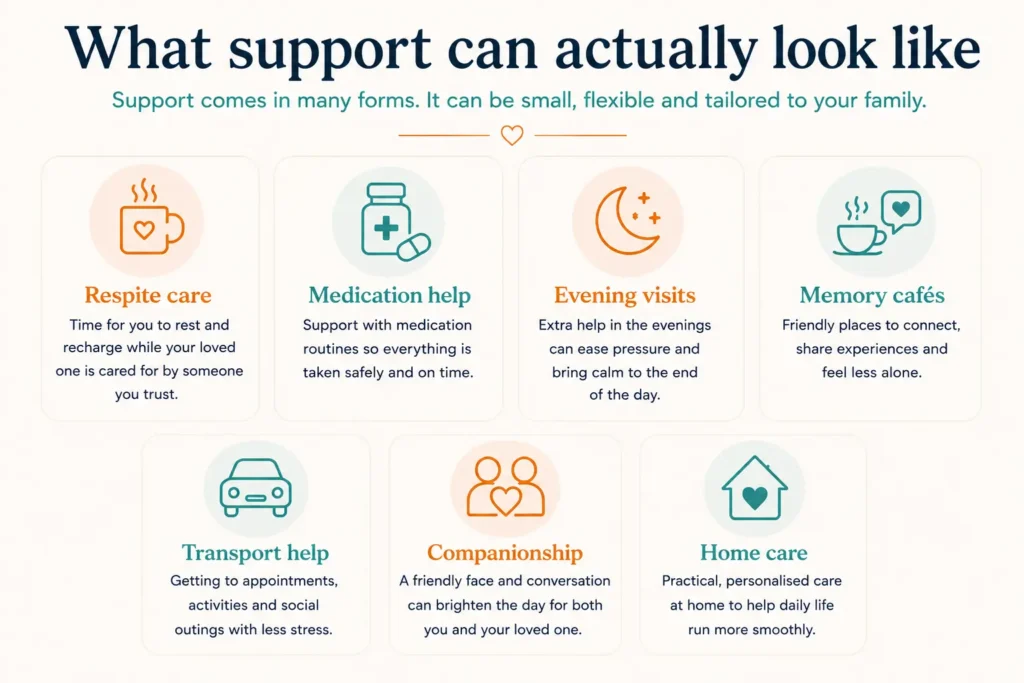
Support does not have to be dramatic to make a difference. You might ask a family member to take one regular slot each week, arrange a short respite visit, use professional home care support, or get help with shopping or medication organisation.
Small changes count. If one task becomes easier or more shared, the whole week can start to feel more manageable.
3. Access formal support early
Many people wait until they are at breaking point before asking for formal support, but you do not have to wait for a crisis.
If caring is affecting your health, sleep, mood, work, relationships, or ability to cope, speak to your GP and contact your local authority or adult social care team. They can help you understand what support may be available where you live.
A Carer’s Assessment is an important step. NICE guidance explains that unpaid carers have the right to an assessment of their own needs, separate from any assessment for the person they support. This can help identify whether you may need support such as respite care, equipment, practical help, adaptations, advice, or signposting to local services.
You can usually request a Carer’s Assessment through your local council. It is there to look at your wellbeing too, not only the needs of the person you care for.
4. Find local and community support
Caregiver burnout can feel even heavier when you are isolated. Speaking to people who understand can make a real difference.
Trusted organisations such as Carers UK, Age UK, and the Alzheimer’s Society offer helplines as well as local support and resources for unpaid carers. Many families also find support through local carers’ groups, dementia support groups, or Memory Cafés.
Unique Senior Care runs Memory Cafés where families can connect with others, feel understood, and reduce some of the isolation that often comes with caring.
5. Test one change, then review how you feel
Once you have made one change, give it a little time. Jo suggests trying it for a couple of weeks and noticing what shifts.
You might ask yourself:
- Is my energy any better?
- Am I sleeping more easily?
- Do I feel less irritable or overwhelmed?
- Does the hardest part of the day feel more manageable?
- Is caring feeling slightly safer or calmer?
You do not need to fix everything at once. Start by easing one pressure point, then build from there. Even a small amount of support can create enough breathing space to think more clearly about what needs to happen next.
When to get urgent help
Caregiver burnout can usually be eased with the right support, practical changes, and earlier intervention. But sometimes the pressure reaches a point where urgent help is needed.
Seek immediate support if:
- You feel at risk of harming yourself or someone else
- The person you care for is unsafe
- You no longer feel able to continue caring safely
- Your physical or mental health is rapidly worsening
- You are experiencing severe anxiety, depression, panic, or crisis thoughts
- There is a medical emergency
If you feel unsafe or at immediate risk, call emergency services. If your mental health is reaching crisis point, contact your GP, NHS 111, Samaritans, or your local mental health crisis service as soon as possible. You do not have to wait until things become unmanageable before asking for urgent support.
Support before caregiver burnout reaches crisis point
If you have recognised yourself in some of these signs, it does not mean you are failing. More often, it means you have been carrying too much for too long without enough support around you.
Caregiver burnout is much easier to manage when you recognise the pressure building early, rather than waiting until everything feels overwhelming. If you are starting to wonder whether caring has become too much to manage alone, our “Is It Time for Care?” tool can help you step back, assess your situation more clearly, and understand what kind of support may help next.
If you’d prefer to talk to an expert, our friendly expert team is on hand to help you understand understand your options and what support might help.
External references:
- Unpaid carers feeling overwhelmed, with over half saying they need more support from councils to take a break | Carers UK
- https://www.carersuk.org/media/mtvkquhy/cuk-state-of-caring-2025-cost-of-caring-report-web.pdf
- Burnout – Mental Health UK
- Carers’ breaks and respite care – Social care and support guide – NHS
- Support services and groups for carers | Age UK
- Getting help and support as a carer | Alzheimer’s Society
- Helpline and other support | Carers UK

Jo joined Unique Senior Care as a Carer in 2011, transitioning from a nursing background. With 25 years of experience in health and social care, including mental health and children with disabilities, Jo has embraced numerous growth opportunities within the company.
Passionate about learning and development, Jo earned a Level 5 Diploma in this field and is committed to equipping teams with the skills needed for outstanding care.
Jo’s qualifications include advanced training in people handling, risk assessment, safeguarding, basic life support, first aid, health and safety, and dementia care. Jo has also completed numerous workshops and CPD courses, such as the SCIE’s Co-Production webinar.
These accomplishments reflect Jo’s dedication to fostering a culture of safety and excellence in care.