

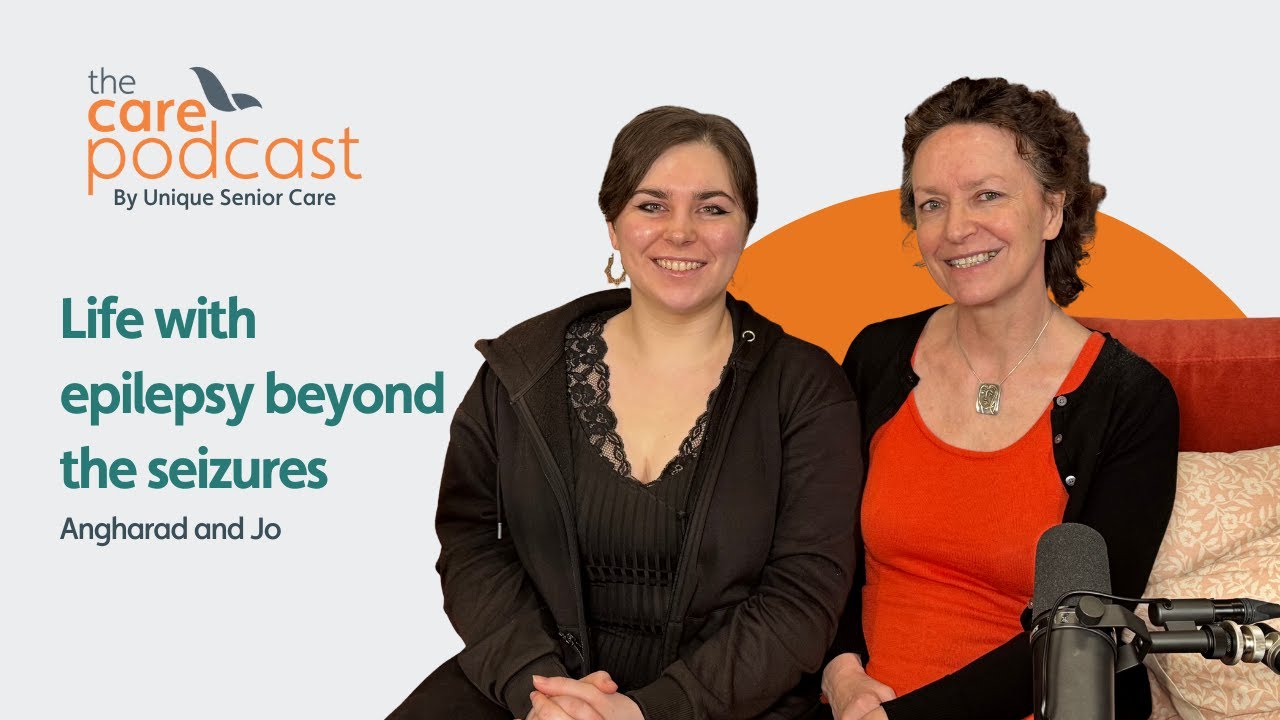
Life With Epilepsy After a Life-Changing Seizure-Related Accident
Episode 6 • 59:18
When people hear the word epilepsy, they often think about seizures alone.
What they do not always see is everything that sits around them - the memory loss, the confusion, the loss of confidence, and the isolation that can shape everyday life.
Angharad developed severe epilepsy as a teenager. Over time, her seizures became so frequent and unpredictable that large parts of her life were lost to memory gaps and confusion. In her early twenties, she was involved in a serious accident during a seizure, leaving her with significant physical injuries and a long period of rehabilitation.
In this podcast conversation, Angharad talks openly about what life was like before and after that accident, and what support really means to her now.
“Without my Caregivers, I would be very alone at home. Both my parents work, and my siblings have gone to university, so there wouldn’t be anyone else around. I can’t leave the house on my own, and I can’t drive. They keep me company, help me get to places, and give me someone to do things with. Without them, I would be stuck."
Angharad - Unique Senior Care Client
Living with memory you cannot rely on
One of the hardest things Angharad describes is not the seizures themselves, but what they took away over time.
Before her accident, her epilepsy was severe and constant. She talks about long stretches where memories simply did not form. Conversations would happen, but they would not stay. Mornings and afternoons blurred together. Large parts of her life disappeared altogether.
She explains that repetition was not a habit, but a necessity. Information had to be repeated again and again because her brain could not hold on to it.
For families, this can be difficult to understand. From the outside, someone may appear present and capable. Inside, they may be working much harder just to keep up with what is happening around them.

Losing independence
Angharad also talks about how epilepsy limited her independence in ways people often overlook.
She cannot drive. She cannot safely leave the house alone. And because she lives in a village, getting anywhere means relying on someone else.
That affects everyday things people often take for granted. Popping out for a coffee. Accepting last‑minute invitations. Deciding to go somewhere on a good day. Even when she feels well, the risk of a seizure means she cannot simply leave the house on her own.
As her siblings moved away to university and her parents worked, long days at home became very quiet. Without support, Angharad would have spent most of that time alone, with no safe way to get out or see anyone.
Over time, this can chip away at confidence, motivation, and a sense of being part of the world around you.
Why companionship matters just as much as safety
When Angharad talks about her Caregivers, she does not focus on tasks.
She talks about what having someone there makes possible.
Having someone to sit with when the day feels long. Watching TV together and actually following what is happening. Cooking once a week and being part of something normal. Playing games. Talking properly, without feeling rushed, corrected, or watched.
These moments may sound small, but for Angharad they are the difference between passing time and living it.
Companionship is what turns care from something purely practical into something that feels like life again.
For Angharad, support means being able to do ordinary things with someone else there – safely, but without feeling managed, monitored, or reduced to her condition.
A mother’s perspective: living without constant fear
Jo is Angharad’s mum. She speaks honestly about what life was like before care was in place, when her daughter was often at home alone and seizures could happen without warning.
Coming home to that sick feeling in her stomach.
Wondering if Angharad had had a seizure.
Fearing another injury, or discovering that something had gone wrong while no one was there.
Knowing that someone is with Angharad does not just protect her physical safety. It allows Jo, as her mum, to work, rest, and live without carrying constant fear in the background of everyday.

When care adapts to real life
Another theme that comes through strongly in the conversation is flexibility.
Life does not run neatly to plan, especially when seizures can happen without warning. Caregivers get ill. Appointments overrun. Plans change at short notice. For Jo, one of the biggest worries was the possibility of Angharad being left alone unexpectedly.
She explains how important it is to know that if something goes wrong, cover can be arranged. That there is always someone to step in, so Angharad is not suddenly without support.
As a regulated care provider, this means having proper contingency plans in place – trained Caregivers who can step in, clear handovers, and oversight to make sure support continues safely.
That reliability removes the constant need for contingency planning and allows families like Jo’s to stop holding everything together on their own.
You can hear more about Angharad's experience with care below:
What other families can take from Angharad’s experience
Angharad’s story is specific, but many families will recognise parts of it.
People living with epilepsy or other neurological conditions may appear well on the surface, while still being unsafe alone. Memory, communication, and confidence can be affected in ways that are not immediately obvious to others.
They may need stimulation and connection, not just supervision. They may be young, capable, and articulate, while still relying heavily on others to stay safe and live a full life.
For families, this can be difficult to explain or even to admit. Support is often seen as something only needed when things become unmanageable. Angharad’s experience shows that the right support can be about protecting independence, not taking it away.
Finding reassurance in the care journey
Living with epilepsy does not just affect the person having seizures. It reshapes family life, independence, and confidence in ways that are often invisible from the outside.
As Angharad and Jo’s conversation shows, the right support does not take life away. It helps make everyday life safer, fuller, and more manageable – for everyone involved.
If this episode has resonated with you, you are not alone. Many families find themselves navigating similar fears, questions, and decisions.
You may also find it helpful to explore more episodes of The Care Podcast, where families and care professionals speak honestly about the realities of care.
And if you are thinking about support for yourself or someone you love, our team is here to talk things through. Helping families make sense of care is what we do.
You may also find it helpful to visit our Care Advice Hub, where we share practical guidance for families navigating care decisions.
Episode details
- Series
- The Care Podcast
- Episode title
- Life With Epilepsy After a Life-Changing Seizure-Related Accident
- Release date
- Duration
- 59:18
- Episode
- Episode 6
- Season
- Season 1
- Host
- Jo Cleary
- Guest
- Angharad & Jo
- Produced by
- Unique Senior Care


Jo joined Unique Senior Care as a Carer in 2011, transitioning from a nursing background. With 25 years of experience in health and social care, including mental health and children with disabilities, Jo has embraced numerous growth opportunities within the company.
Passionate about learning and development, Jo earned a Level 5 Diploma in this field and is committed to equipping teams with the skills needed for outstanding care.
Jo’s qualifications include advanced training in people handling, risk assessment, safeguarding, basic life support, first aid, health and safety, and dementia care. Jo has also completed numerous workshops and CPD courses, such as the SCIE’s Co-Production webinar.
These accomplishments reflect Jo’s dedication to fostering a culture of safety and excellence in care.