How to Cope with the Worry of Caring for an Ageing Parent
Episode 14
Caring for an ageing parent can bring a constant, underlying worry that is hard to switch off.
You might find yourself thinking about them while you’re at work. Wondering if they’re safe at home. Feeling stretched between your own responsibilities and the growing needs of someone you love.
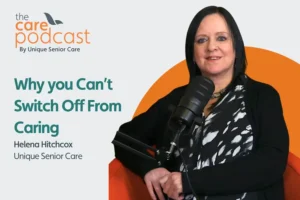
In this episode of The Care Podcast, Jo speaks to our Operations Director, Helena Hitchcox. She shares practical advice and reassurance to help you manage that worry, understand where it comes from, and take small steps that make things feel more manageable.
Why caring for a parent can feel so overwhelming
For many families, the shift happens gradually. You start helping a little more. Then a bit more again. Until one day, you realise the balance has changed.
You are no longer just a son or daughter. You have become the main source of support.
Helena explains that this role reversal can feel emotionally heavy. It can feel like you are losing the parent you once knew, while also trying to step into a role you never expected to take on.
At the same time, life doesn’t pause. You may still be working, raising children, and managing your own home. Trying to carry all of this at once can lead to a constant sense of pressure.
Over time, this can build into what is often called burnout or compassion fatigue. It is not a reflection of who you are. It is a sign that you have been carrying too much, for too long.
The worries families often carry every day
The worry is rarely about just one thing. It tends to be a collection of smaller concerns that build over time.
You might recognise some of these:
- Worrying about safety at home, especially falls or accidents
- Concern about memory loss, confusion, or cognitive decline
- Fear that your loved one may leave the house and get lost
- Feeling guilty for not being there all the time
- Worrying about how care will be funded in the future
- Trying to balance work, family life, and caring responsibilities
As Helena shares in the episode, these worries can become overwhelming because they do not switch off. They follow you throughout the day and often into the night.
Why trying to do everything alone can make things harder
Many families feel a strong sense of responsibility to manage everything themselves. It often comes from love. From wanting to protect your parent and give back to them.
But trying to take on everything can quickly become unsustainable. Helena describes how people often move from “doing with” their parent to “doing for” them. Over time, this can lead to exhaustion, frustration, and even feelings of resentment, which can be difficult to admit.
This is usually the point where families begin to feel stuck. They want to do the right thing, but they are not sure what that looks like anymore.
Simple ways to reduce risk without taking away independence
One of the biggest concerns for families is safety. But keeping someone safe does not mean removing their independence.
There are small, practical steps that can reduce risk while still allowing your loved one to live comfortably at home.
You might consider:
- Improving lighting around the home to reduce the risk of falls
- Keeping walkways clear and free from clutter
- Making sure frequently used items are easy to reach
- Introducing gentle routines to create structure and reassurance
When memory loss is involved, concerns about someone leaving the home can feel particularly worrying. It may be tempting to restrict movement, but locking someone in can create serious safety risks and remove their sense of freedom.
Instead, there are safer alternatives that can offer reassurance without restriction.
How technology can help ease constant worry
Technology can play a helpful role in reducing that ongoing sense of worry, especially when you cannot always be there in person.
Some of the most common options include:
- Personal alarm pendants that connect to a 24-hour call centre
- Fall detectors that alert someone automatically if a fall occurs
- Door sensors that notify you if someone leaves the house
- Careline services linked to local authorities
These systems are designed to provide a safety net. They allow your loved one to remain independent, while giving you reassurance that help is available if it is needed.
For many families, this can be one of the first steps that makes daily life feel a little lighter.
What the Herbert Protocol is and how it can help
If your loved one is living with dementia or memory loss, you may worry about them going missing.
The Herbert Protocol is a simple but valuable tool that can help in this situation. It involves completing a form with important personal information, such as:
- Previous addresses
- Places they have worked
- Favourite locations or routines
- Key personal details
This information can be shared with the police if someone goes missing, helping them locate the person more quickly.
As Helena explains, people often return to places that feel familiar from earlier in life. Having this information ready can make a significant difference in an emergency.
Finding support in your local community
One of the most important messages in this episode is that you are not alone.
There are many forms of support available, and often they can be introduced gradually.
You might explore:
- Day centres that provide social interaction and structured activities
- Memory cafés for people living with dementia and their families
- Local community groups for older adults
- Home care services for practical or personal support
Even a small amount of support, such as companionship visits, can help reduce isolation and give you space to rest and recharge.
It can also help your loved one maintain their independence for longer.
What this means for you as a family
If you are feeling worried or overwhelmed, it is important to recognise that this is a common experience.
Caring for a parent is not something most people feel fully prepared for. The emotional weight, combined with practical responsibilities, can feel like a lot to carry.
But you do not have to solve everything at once. Taking small steps, whether that is exploring technology, speaking to your local authority, or asking for advice, can begin to ease that constant sense of pressure.
As Helena reminds us, this is a journey. And at every stage, there are people and services available to support you.
Continuing the conversation
If you are navigating the care journey, you may find it helpful to explore more episodes of The Care Podcast, where families and care professionals speak honestly about the realities of care.
If you are thinking about support for yourself or someone you love, our team is here to talk things through. Helping families make sense of care is what we do.
You may also find our Care Advice Hub useful, where we share practical guidance for families at every stage of their care journey.
Episode details

- Series
- The Care Podcast
- Episode title
- How to Cope with the Worry of Caring for an Ageing Parent
- Release date
- Duration
- 10:56
- Episode
- Episode 14
- Season
- Season 1
- Host
- Jo Cleary
- Guest
- Helena Hitchcox, Operations Director at Unique Senior Care
- Produced by
- Unique Senior Care

With over 30 years of experience in the care industry, providing outstanding care has always been Helena’s core mission.
Helena has been a dedicated member of Unique Senior Care for 10 years, starting as Care Manager and advancing to Head of Extra Care and now serving as Director of Operations.
She holds a Level 5 Diploma in Leadership for Health and Social Care and Children and Young People’s Services (England), as well as a Diploma in Welfare Services. Helena has completed various leadership and management courses, enhancing her expertise in the care industry.
Helena has authored published articles, including one for Skills for Care on managing change through the COVID pandemic. She has a steadfast commitment to advocating for and supporting those in need, ensuring their voices are heard and their rights upheld.